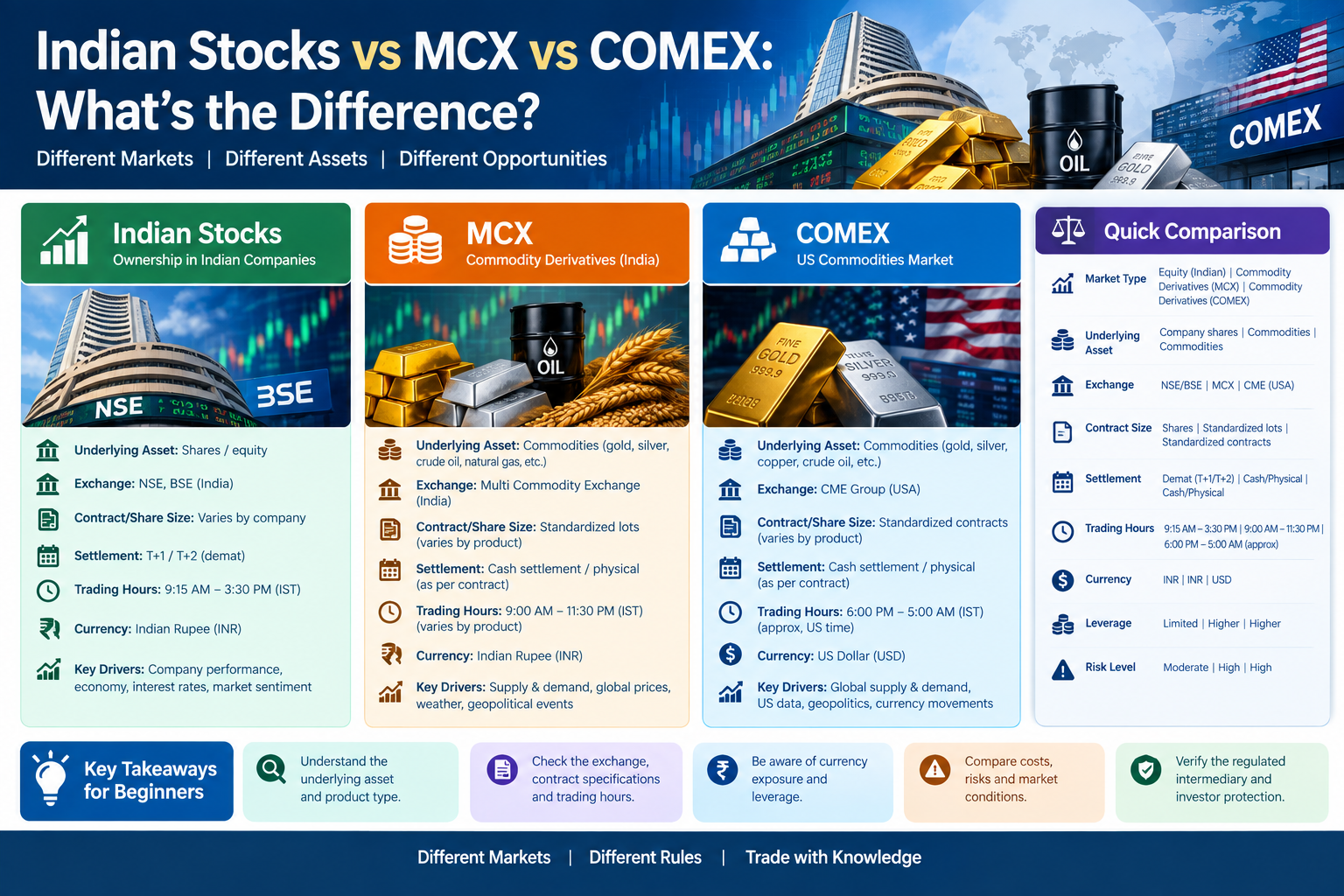
Indian Stocks vs MCX vs COMEX products are often discussed together by people exploring financial markets, but they represent different types of market exposure. A beginner may see familiar names such as gold, crude oil, shares, or indices and assume that all of them are traded in the same way. They are not.
Understanding the market, the underlying asset, the exchange, contract specifications, settlement method, trading hours, and currency exposure can help users interpret these categories more accurately.
What Are Indian Stocks?
Indian stocks represent ownership interests in companies listed on Indian stock exchanges. When an investor buys shares of a company through a regulated market intermediary, the investment is connected to the company’s equity.
Indian equity markets include exchanges such as the National Stock Exchange of India and BSE. The exact products and trading mechanisms depend on the security and market segment.
Stock prices can be affected by company earnings, business conditions, interest rates, economic developments, industry trends, and investor expectations. Equity investing can therefore involve both company-specific and broader market risks.
What Is MCX?
MCX, or the Multi Commodity Exchange of India, is a recognized Indian commodity derivatives exchange. It provides a platform for trading commodity derivative contracts.
Commodity derivatives can include contracts linked to products such as gold, silver, crude oil, natural gas, and other commodities, subject to the exchange’s listed contracts.
Unlike buying a company’s shares, entering a commodity futures position does not generally mean owning physical barrels of oil or quantities of metal. A futures contract represents an agreement with standardized specifications defined by the exchange.
What Is COMEX?
COMEX is a commodities exchange market operated as part of CME Group in the United States. It is widely associated with precious-metals futures and options, including gold and silver contracts.
COMEX contracts have their own specifications, trading schedules, tick values, contract sizes, and settlement arrangements. Because the market is based in the United States, international traders can also encounter currency and time-zone considerations.
Stocks vs Commodity Derivatives
The most fundamental difference is the underlying exposure. A stock represents equity in a company, while a commodity derivative is a financial contract linked to a commodity.
An investor studying an Indian company might focus on revenue, margins, debt, management, competition, and future growth. A trader studying a commodity may pay more attention to supply and demand, inventories, weather, geopolitical developments, production levels, and global economic conditions.
Leverage is another important difference. Derivative contracts are generally designed around margin requirements, meaning a trader can control a contract value without paying the full notional amount upfront. This can magnify both gains and losses.
Contract Specifications Matter
Before trading a commodity derivative, a user should understand contract size, tick or price movement value, expiry, margin requirements, trading hours, and settlement method.
For example, two contracts referencing the same broad commodity may have different specifications. Assuming that all gold or crude contracts behave identically can lead to incorrect risk calculations.
Currency and Global Exposure
Indian Stocks Market are primarily connected to India’s corporate and economic environment, while commodities such as gold and crude oil are influenced by global markets.
COMEX pricing is generally quoted in US dollars. An Indian participant may therefore be exposed to currency movements in addition to the underlying commodity’s price movement, depending on the product and route used.
MCX products are traded in the Indian market and have their own exchange specifications. Global commodity prices can influence them, but the relationship is not necessarily a simple one-to-one movement at every moment.
Trading Hours
Trading schedules are another difference. Indian equity and commodity markets operate according to their respective exchange calendars and sessions. US markets such as COMEX follow US schedules, which means Indian users need to consider time-zone differences.
Trading hours can affect liquidity, news reactions, and the timing of price movements.
Risk Considerations
Stocks can lose value if a company performs poorly or market expectations decline. Commodity derivatives can move sharply due to global supply-demand developments and may involve substantial leverage.
Derivatives can therefore require careful position sizing. A small percentage movement in the underlying can produce a larger percentage change relative to the margin posted.
How Beginners Can Compare the Markets
A useful comparison starts with five questions: What is the underlying asset? Which exchange lists the product? What is the contract or share size? How is the position settled? What risks affect the price?
Beginners should also verify the regulated intermediary through official sources and read the current contract specifications rather than relying on informal explanations.
Conclusion
Indian stocks, MCX, and COMEX provide different forms of market exposure. Stocks are equity instruments connected to companies; MCX provides a regulated Indian marketplace for commodity derivatives; and COMEX is a US commodities market known for contracts including precious metals.
None of these markets should be judged only by potential returns. Their structures, leverage, trading hours, costs, and risks are different. Understanding those differences is a practical first step before deciding which market, if any, fits a person’s objectives and risk tolerance.
Anyone comparing Indian stocks with commodity markets should understand the underlying product before trading. The relationship between Indian stocks, MCX Trading products, and COMEX contracts involves different exchanges, contract specifications, trading hours, price drivers, and risk characteristics.