
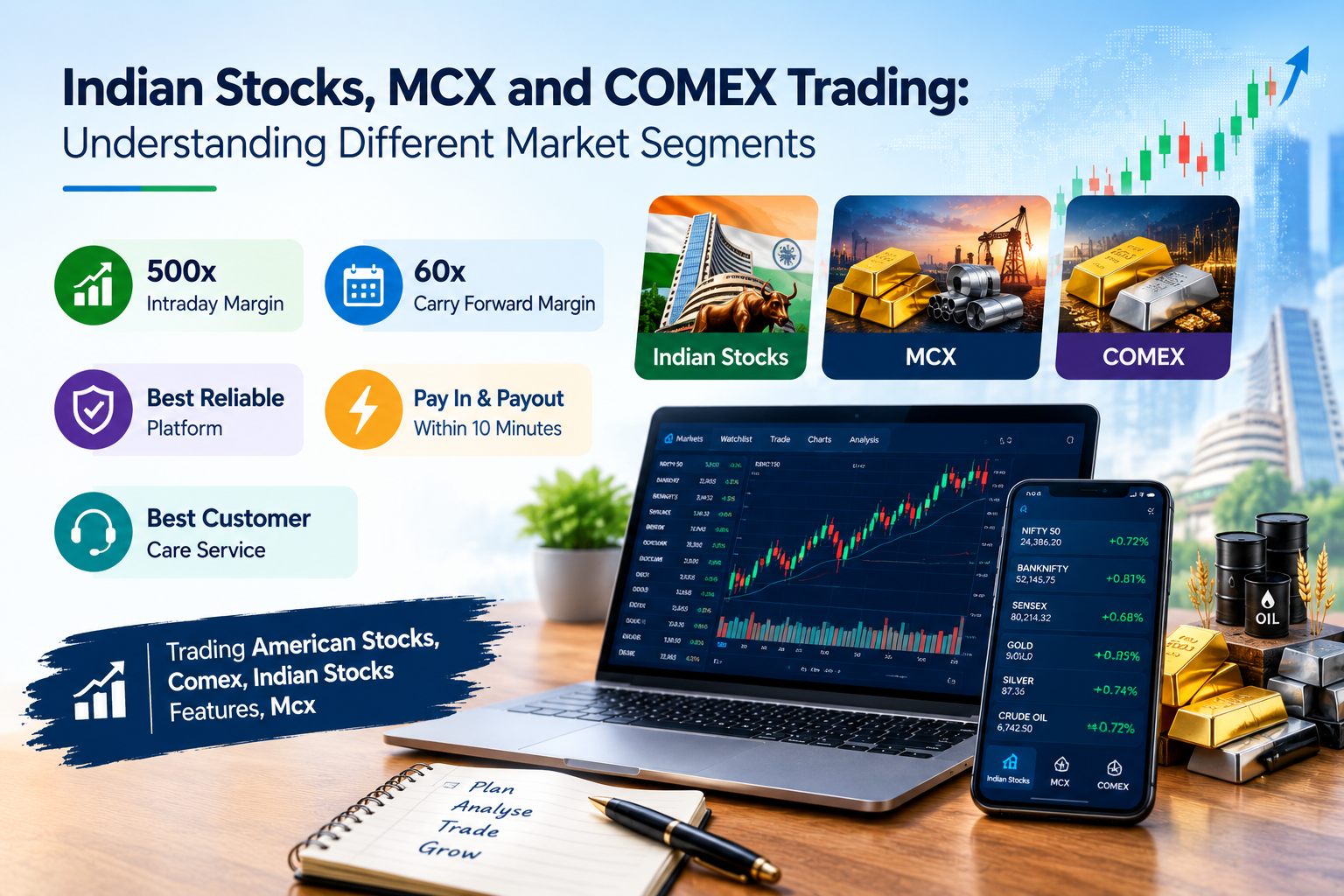
Financial markets are divided into different segments because each market serves a different economic purpose. Indian equities represent ownership in companies, while commodity markets provide ways to trade or hedge exposure to products such as metals and energy. International commodity markets add another layer through global pricing and currency effects. Understanding these distinctions is essential before selecting a dabba trading platform or comparing different trading arrangements.
Indian stocks and equity exposure
When people buy shares of listed Indian companies through a regulated Indian stocks market structure, they are participating in an equity market. Prices respond to company earnings, expectations, interest rates, economic growth, sector developments and investor sentiment. Equity trading can be approached through delivery-based investing or shorter-term strategies, depending on the product and applicable rules.
A trader should understand the difference between owning a security and taking a short-term position based on price movement. The risk profile, costs and holding period can vary significantly.
MCX and commodity markets
MCX is associated with commodity derivatives in India. Commodity contracts can provide exposure to metals, energy and other commodities without requiring the trader to physically handle the underlying product. Prices may respond to global supply and demand, currency movements, inventories, geopolitical events and domestic factors.
Commodity derivatives can be volatile. Contract size, expiry, margin requirements and settlement specifications need to be understood before trading. A small price movement in the underlying commodity can have a meaningful impact when a leveraged futures position is involved.
COMEX and global commodity pricing
COMEX is a major international marketplace associated with metals futures. Gold and silver are often watched globally, and international prices can influence domestic commodity sentiment. However, a trader in India may also be affected by currency movements and local market conditions.
This means a simple comparison of two quoted prices may not tell the whole story. Traders should understand the contract, unit, currency and trading hours involved before drawing conclusions about price differences.
Why market segments behave differently
Equities, domestic commodity derivatives and international commodity markets respond to different drivers. A company’s share price may react strongly to earnings or management decisions, while gold may respond to interest-rate expectations, currency conditions and risk sentiment. Energy commodities can be heavily influenced by supply disruptions and geopolitical developments.
Diversification across markets can reduce dependence on one type of economic event, but it does not eliminate risk. Each market has its own liquidity, volatility and margin characteristics.
Margin and leverage across markets
Derivatives generally involve margin rather than paying the full notional value upfront. This can make positions capital-efficient, but leverage can also amplify losses. Traders should calculate the monetary impact of a price movement using the actual contract specifications.
A platform that advertises very high exposure may appear attractive, but the headline figure tells little about the total risk, liquidation rules or costs. Responsible trading begins with understanding the contract rather than focusing only on the amount of leverage available.
Regulated access matters
Market terminology can be used by many websites, but access to a market is not the same as lawful participation in its regulated infrastructure. A dabba trading platform may quote prices linked to Indian or international markets without providing the same exchange-based execution and settlement framework.
Users should verify where an order is executed, how the transaction is recorded and what legal protections apply. Clear statements, identifiable counterparties and transparent withdrawal procedures are important warning signs to examine before depositing funds.
Building a market-specific plan
A sensible strategy starts with the instrument. For equities, a trader may study company fundamentals and sector trends. For commodities, global supply-demand information, macroeconomic data and contract structure may be more important. International products also require attention to currency and trading-hour differences.
The same risk-management rules still apply: define the maximum acceptable loss, size positions carefully and avoid taking exposure that cannot be supported during volatility.
Conclusion
Indian stocks, MCX and COMEX-linked markets can provide very different trading experiences. Learning how each market works is more valuable than assuming that one strategy fits every instrument. When researching dabba trading in india, users should also distinguish market exposure from the regulatory structure through which a trade is executed and settled.
Understanding the market segment, contract terms, margin requirements and legal framework should come before choosing a platform or taking a position.
Keyword note: Readers comparing services should research dabba trading in india carefully, verify the operator’s identity and understand how orders, records, settlement and withdrawals are handled.
Keyword note: Readers comparing services should research dabba trading app carefully, verify the operator’s identity and understand how orders, records, settlement and withdrawals are handled.
Keyword note: Readers comparing services should research dabba trading app carefully, verify the operator’s identity and understand how orders, records, settlement and withdrawals are handled.
Reading contract details
A market name is not enough to identify a trade. Check the exact instrument, expiry, contract size, tick value, currency and trading session. These details determine how a price movement translates into money.
This is especially important when a platform combines Indian and international markets. Two instruments may track related assets while having different specifications and risk characteristics. Traders should understand those differences before assuming that prices or strategies are interchangeable.
Market diversity creates opportunity but also complexity. Every instrument should be evaluated on its own terms.
Users should also distinguish between information and execution. A chart can be accurate while the service displaying it is unsuitable for placing a real transaction. Review every important claim independently, especially claims involving regulation, returns, leverage and withdrawals. Taking additional time at the beginning is usually easier than trying to resolve a problem after money has already been transferred.








Pingback: Indian Stocks vs MCX vs COMEX: What's the Difference? - DabbaTrading